
COMMERCIAL BANK OF CEYLON
RANK 7
“Commercial Bank has deeply embedded sustainability into its governance, strategy and operations, establishing a comprehensive framework that spans the entire organisation”

Managing Director
Chief Executive Officer
Q: As Sri Lanka continues to pursue economic and political stability, how is the corporate sector driving growth while overcoming challenges that persist on many fronts?
A: Sri Lanka’s corporate sector continues to be a catalyst for economic revival, demonstrating resilience and commitment despite the broader operating challenges.
The banking sector in particular plays an essential role by expanding access to credit, and empowering businesses to stabilise, scale up, improve profitability, generate employment and strengthen their contributions to the national economy.
This positive momentum is clearly reflected in the quarterly financial performance of banks. Commercial Bank of Ceylon, for example, expanded its loan book by Rs. 230 billion in 2024 and by a further 381 billion rupees during the first nine months of 2025, reinforcing its steadfast support for the country’s recovery efforts.
And this growth is complemented by disciplined yield management and a sharp focus on cost optimisation, ensuring sustainable progress in line with market conditions.
Q: How is the bank faring against the backdrop of the prevailing macroeconomic milieu?
A: The Commercial Bank of Ceylon Group has continued to demonstrate strong adaptability and disciplined performance despite the challenging macroeconomic environment.
In 2024, the bank effectively navigated the impact of the Sri Lanka International Sovereign Bond (SLISB) restructuring through prudent provisioning, robust balance sheet management and sustained lending growth. During this period, the bank also maintained a healthy current account and savings account (CASA) ratio while managing its funding costs with precision.
Following the severe natural disaster which the country experienced in late November, the bank remains fully committed to supporting its customers, communities and the national rebuilding process.
Commercial Bank has been present and dependable through every challenge the country has faced – from economic shocks to natural calamities – and continues to stand with the nation today.
The bank is poised to assist affected individuals and businesses through targeted relief measures, flexible financial solutions and uninterrupted access to essential banking services, reinforcing its role as a long-term partner in resilience and recovery.
These measures have positioned the organisation to deliver stable and equitable growth in the current financial year, underscoring its resilience and long-term value creation mindset.
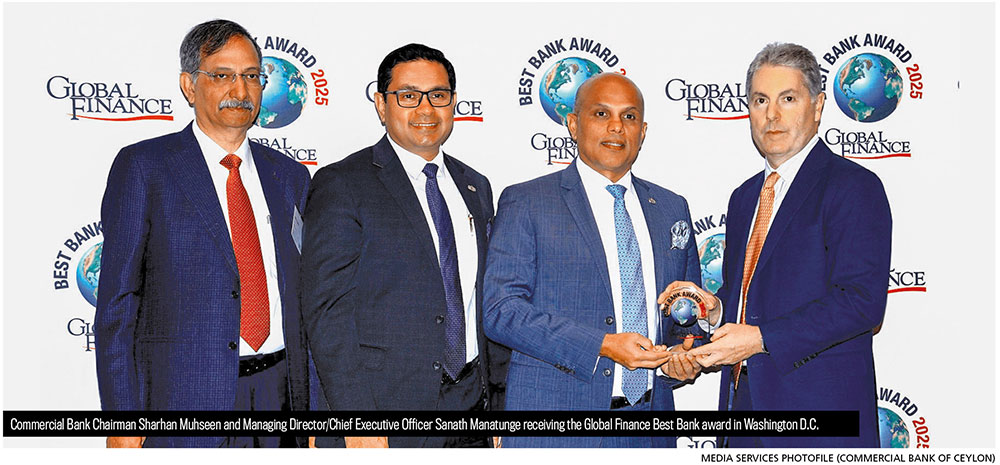
Q: In your view, how do global business and geopolitical dynamics impact Sri Lankan businesses?
A: As a small, export driven economy, Sri Lanka is naturally sensitive to global economic trends and geopolitical developments. Many of the country’s key industries rely on imported raw materials and the fuel requirement is sourced from overseas, increasing exposure to global price and supply fluctuations.
Traditional export sectors such as tea, where Sri Lanka once held global leadership, have also experienced heightened international competition. Recent developments such as shifts in US tariff policies highlight how global decisions can disproportionately affect smaller economies.
To navigate these realities, local businesses must continue diversifying export markets, focussing on value added products and reducing overdependence on a limited set of destinations, thereby strengthening long-term resilience.
Q: What trends do you observe in your sector – and what have you done as a business to optimise some of these?
A: The banking sector is evolving rapidly, driven by three major trends: digitalisation, the integration of AI and a transition towards verifiable sustainability. Commercial Bank has taken a leadership role in each of these areas.
ComBank Digital has emerged as one of the country’s most widely used digital banking platforms, serving more than 1.78 million registered users and processing over Rs. 600 billion in transactions monthly.
The platform offers an extensive suite of services – from payments and investments to lifestyle features – supported by strong security protocols and round-the-clock accessibility. Recent enhancements such as loyalty rewards for transactions reflect the bank’s commitment to continuous innovation.
In terms of artificial intelligence, Commercial Bank has introduced the country’s first AI powered SME credit underwriting solution – an advanced, scalable platform leveraging predictive analytics and behavioural insights to more accurately assess the financial needs of small and medium-sized enterprises. This marks a notable step in expanding credit access to the SME sector.
On the sustainability front, the bank continues to advance its ambitious environmental, social and corporate governance (ESG) agenda through sustainable banking, responsible practices and community focussed initiatives. Having already achieved carbon neutral status, the bank is now progressing towards self-carbon neutrality by 2030 and net zero emissions by 2050.

Q: And what are the challenges facing the banking sector in general?
A: The banking sector operates in a landscape where macroeconomic variables remain dynamic and stakeholder expectations – whether from customers, regulators or policymakers – continue to rise. Expanding lending remains a priority and this requires accelerating fund mobilisation while carefully managing the cost of those funds to maintain healthy margins.
As portfolios grow, prudent provisioning for impairment and sound capital adequacy management become increasingly important. These challenges, however, are well within the bank’s capabilities – as demonstrated by Commercial Bank’s consistent, resilient financial performance and strong governance frameworks.

Q: How is the bank embracing ESG standards?
A: Commercial Bank has deeply embedded sustainability into its governance, strategy and operations, establishing a comprehensive framework that spans the entire organisation. The CEO, board of directors and an executive sustainability committee led by the Chief Executive Officer – supported by a dedicated sustainability unit – oversee implementation, ensuring alignment with both national priorities and global standards.
In the aftermath of the recent natural disaster, the bank’s ESG commitments have taken on even greater significance. This underscored the urgent need for climate adaptation, disaster resilience and sustainable infrastructure.
And in response, the bank has strengthened its focus on supporting affected communities, prioritising green financing and enhancing climate risk assessment mechanisms across its portfolio.
Sustainability responsibilities now extend to every major business function including credit, risk, finance, operations, IT, customer service, HR, procurement and digital banking – making ESG integration a core component of the bank’s operating model.
The bank has incorporated social and environmental risk scoring into lending, manages financed emissions in collaboration with the IFC, and has aligned departmental key performance indicators with the Central Bank of Sri Lanka’s Sustainable Finance Roadmap 2.0 and international reporting frameworks.
As a leader in sustainability advocacy, Commercial Bank recently hosted Sri Lanka’s first bank led sustainability summit and is the first in the country to adopt International Financial Reporting Standards (IFRS) S1 and S2 reporting.
The bank’s achievements – including recognition by the International Finance Corporation for excellence in Climate Assessment for Financial Institutions (CAFI) reporting and the development of a climate transition plan – highlight its commitment to a low carbon, climate resilient and socially responsible future.
Telephone 1316 | Email info@combank.net | Website www.combank.lk