LMDtv 1
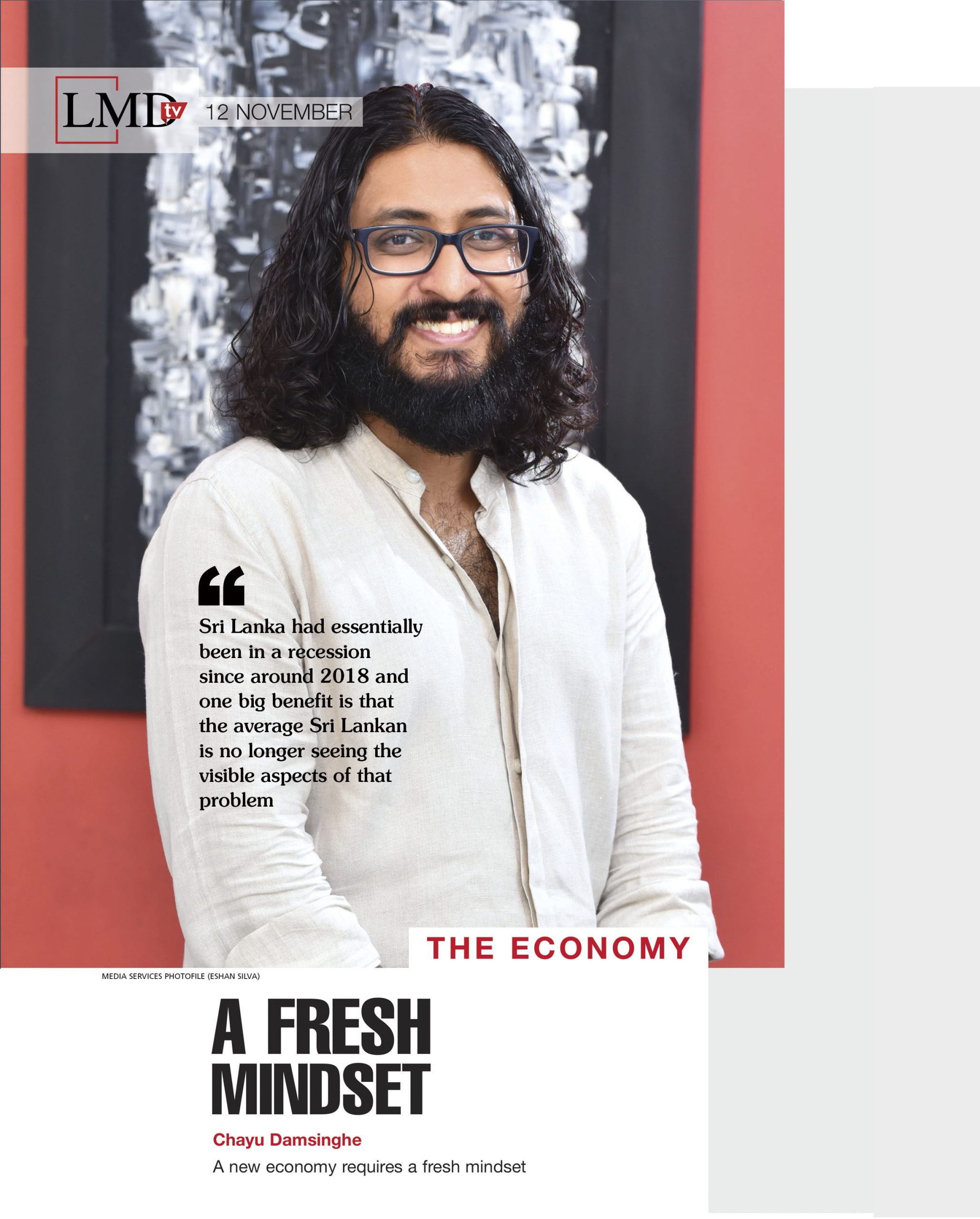
Turbulence and volatility seem to be the order of the day when it comes to global trade and economics – but Sri Lanka has adopted a positive stance, noted the Head of Macroeconomic Advisory at Frontier Research Chayu Damsinghe.
On a recent airing of LMDtv, he noted: “We are in a relatively positive place given everything that we’ve been through as a nation.” The need now is that the country “moves from being an economy that ran on deficits to one that’s running on a surplus.”
Damsinghe added that Sri Lanka’s current position “fundamentally changes the characteristics of the country since it’s on a very different macroeconomic footing. It might take time for people to get used to what that means because it’s a completely new economic story.”
He remains optimistic about the movements in currency value and interest rates, explaining that “Sri Lanka had been running a primary fiscal deficit since the 1950s, whereby the government spent more than it earned.”
“So at times, we needed to borrow money; and when the economy stabilised at some point, the rates would increase; and when the economy wasn’t looking healthy, they’d drop. This pattern continued in a vicious cycle for decades,” he added.
Damsinghe continued: “But now for the third year running, we are essentially in reverse, and running primary fiscal surpluses and external current account surpluses.”
“When you have a surplus, the context of the economy changes. It has moved from being volatile with predictable cycles of rates and currency determined by local factors to one that’s a lot more stable. But on the flip side, it’s also exposed to various types of risk factors,” he elaborated.
And he outlined the most significant risk on the horizon for Sri Lanka from a global perspective: “Over the last 20-25 years, the world economy has essentially been simplified to the fact that China produces, the US consumes and everyone else is in the middle. Now we’re moving away from that scenario, and it’s going to lead to plenty of change – but what it will be is unclear.”
The other risk for Sri Lanka is of a domestic kind.
Damsinghe elaborated: “The fundamentals of the economy have shifted in an extremely noteworthy manner away from where they were previously. I don’t think many people in Sri Lanka really understand how to work with an economy like that.”
“If we engage with the economy assuming it’s similar to that of the past, the decisions that individuals, businesses, investors and the government make will be very difficult to relate to the reality of the economy. So bad decisions can perhaps be a risk factor,” he cautioned.
He continued: “Sri Lanka had essentially been in a recession since around 2018 and one big benefit is that the average Sri Lankan is no longer seeing the visible aspects of that problem. This could be because their salaries have probably begun to increase and prices aren’t rising as much as they were earlier.”
“However, there are also the less visible aspects of this – such as knowing how one’s future prospects have improved until one gets to that point,” he conceded.
He asserted that “there aren’t any big movements in prices or interest rates. As a result, you can plan for the long term because you’re moving from an economy that was more boom-bust and driven by government decisions to one that’s more private sector driven.”
What’s more, “this also means that parts of the economy that were based on the previous economic context may struggle to adapt while others will do very well,” he posited.
Having the right mindset is crucial. To this end, Damsinghe opined that “it’s about being confident and believing in what we have right now, and not misinterpreting this phase as a bounce back or a version of the previous economy.”
In summing up his interview, he noted that “this is a new type of economic structure; it’s a new economy that requires a new mindset.”