TRANSPORT SECTOR
Sri Lanka’s first motor omnibus was imported back in 1907. This heralded a private, unregulated bus service with pioneers such as T. W. Collette operating the Thorneycroft driven service from Colombo to Chilaw. It eventually resulted in the formal regulation of public transport and its subsequent nationalisation.
Since then, our public transport system has succeeded to some extent but failed most of the time; and lately, it has witnessed a downward spiral.
HIGH ROADS TO NOWHERE!
Janaka Perera rues our public transport and calls for an urgent makeover
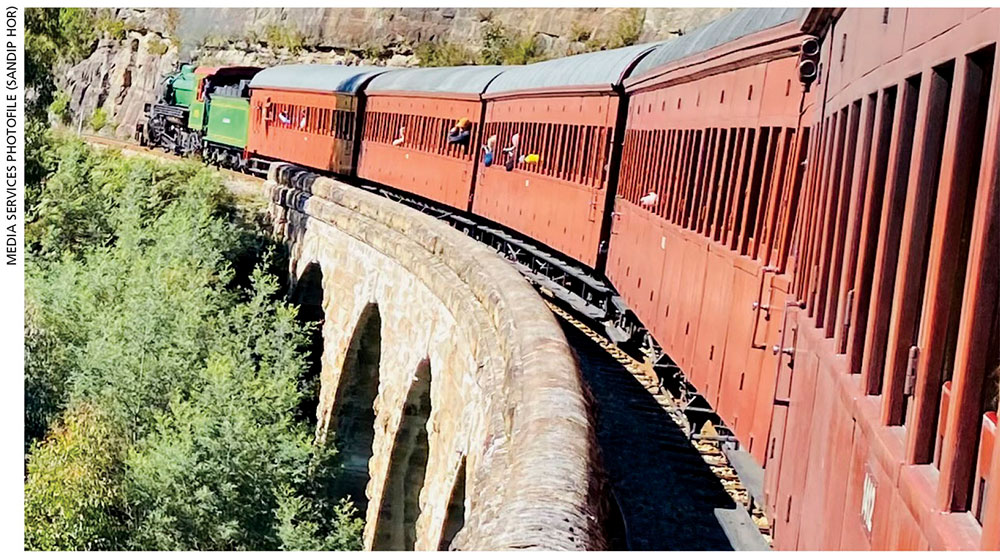
Railways were introduced to this country before Japan did so. But look where Japanese trains are today and the state of Sri Lanka’s railway service! We have such dilapidated office train compartments that commuters have to unfurl their umbrellas when it’s raining – because water leaks into the compartments!
Frequent strikes plague our railway services, affecting both locals and tourists. Sri Lankans must wonder whether even their great-grandchildren will enjoy high-speed luxury trains operating locally as their Japanese and Chinese counterparts do.
The golden era of Sri Lanka Railways was when B. D. Rampala was its general manager and chief mechanical engineer.
Rampala sought to upgrade the railways and in the mid-1950s, he launched express trains to reduce journey times to major destinations with the Yal Devi (Princess of Jaffna), which operated between Colombo and Jaffna; and the Udarata Menike (Upcountry Maiden) travelling between Colombo and Badulla.
And when he launched the Ruhunu Kumari (Princess of the South) service in 1955, Rampala himself journeyed on the train from Colombo to Matara.
Until the 1950s, the then Ceylon Government Railways (CGR) operated with a lock and block signalling system. Rampala then introduced electronic colour signalling for the busiest sections of the railways in 1959. A centralised traffic control panel at Maradana was later able to control the movement of trains and improve safety.
The halcyon days of our bus services were when Anil Moonesinghe was chairman of the Central Transport Board (CTB). He ordered the construction of a new building complex at the central bus terminus in Pettah and travelled in buses to understand the problems commuters faced.
Though he was a Lanka Sama Samaja Party (LSSP) stalwart, Moonesinghe didn’t hesitate to punish even employees with LSSP membership for wrongdoings.
And in the 1950s, single decker trolleybuses with electronically operating doors and double-deckers were introduced to replace tramcars in the city.
But it has become necessary to improve the public transport system as a whole – urgently!
Among the imperatives are the implementation of a single ticketing or payment system (card or app) for buses, trains and potentially ride sharing transport for digital ticketing, to offer transparency and convenience; and GPS tracking for real-time updates and multimodal hubs in major cities – for example, Colombo and Kandy.
And we need to replace old buses and upgrade railway rolling stock; and expand routes and extend lines to serve a wider range of passengers. Serving growing populations – especially in rural areas with state support for low income demographics – as well as establishing a bus rapid transit (BRT) with dedicated lanes for faster journeys are important too.
There’s also a dire need to improve facilities for travellers, waiting areas and cleanliness to attract middle-class commuters. And traffic laws (speeding, and drink and reckless driving) should be strictly enforced to ensure discipline – particularly in the case of buses and three wheelers.
Moreover, scheduling and management have to be more efficient so that arrival times of buses and trains are predictable.
And there is a need to revamp politicised entities such as the Sri Lanka Railways (SLR) and Sri Lanka Transport Board (SLTB) by appointing strong nonpolitical leadership, in addition to encouraging private sector investments and expertise through public-private partnerships (PPP).
Sri Lanka’s public transport also needs improvement through integration (e.g. single ticketing and hubs), modernisation (electric buses, new locomotives and digital tracking), quality upgrades, policy reforms and improvements to the system.
Likewise, public transport fleets need to be modernised by replacing old buses with energy efficient low emission models – including electric buses and upgraded railway carriages. Smart pricing by utilising revenue from expressway tolls to fund public transport is another imperative.
A foreign funded light railway transit (LRT) system was proposed in 2012 but has yet to see the light of day. In the first stage, the LRT was to operate a 10 kilometre parallel run from the Colombo Fort to Battaramulla; and the second was to be a 19 kilometre stretch from Moratuwa to Maradana, which would be extended to Kaduwela.
But the government of the day arbitrarily cancelled the project in 2019 and the LRT has never got back on the fast track again!