LMDtv 4
“Despite being on a par – or sometimes even better – with their male counterparts, you do see a tendency for women to not get the breaks they deserve ”
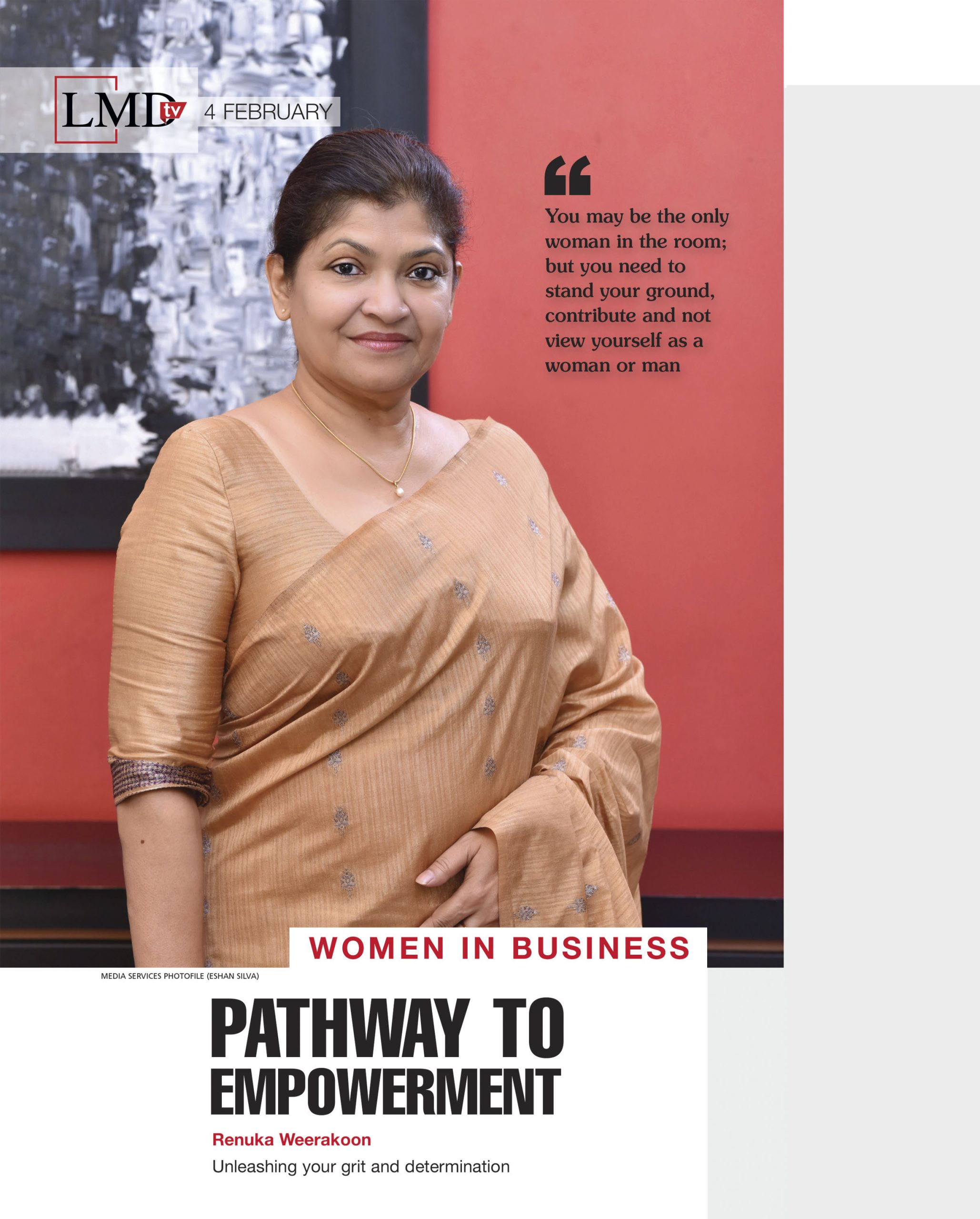
Sri Lanka has made notable progress in terms of women’s empowerment but there is still room for improvement. “Despite being on a par – or sometimes even better – with their male counterparts, you do see a tendency for women to not get the breaks they deserve, makingit harder to break the glass ceiling,” noted the Director General and CEO of the Board of Investment of Sri Lanka (BOI) Renuka Weerakoon.
During a discussion on LMDtv not long ago, she expressed optimism about advancements in women’s empowerment in organisations and the potential to raise the bar further. Across industries and sectors such as manufacturing, agriculture and tourism, especially when considering BOI companies, there is an equal ratio of females to males.
“Today, if you look at the airlines, you see female pilots. In the port sector too, we see more women. Though cranes were previously handled only by males, now with technology females too are able to load and unload cargo from ships,” she noted.
While the pandemic posed several challenges to work and life around the world, it also paved the way for more innovative ways of working such as remote work that opened doors for more women to enter and remain in the workplace.
She explained that women with young children often had to leave their jobs due to childcare responsibilities, though still having the ability and potential to contribute to economic activity. And while work was traditionally a 9 a.m. to 5 p.m. affair, the concept of remote working has enabled women who left organisations to return to the workforce.
“I have seen many private companies helping women upskill if they had been at home for two or three years because they may need upskilling before returning to the workplace,” she added.
Weerakoon continued: “We saw a significant number returning to work, especially in the digital and IT sectors. Organisations have now adapted to being able to assign work to someone who will be able to complete an assignment irrespective of timelines. This has provided a lot of flexibility for young mothers – and even older mothers – who still have the capacity to contribute.”
She also explained that when new zones are established, the BOI factors in childcare infrastructure so that mothers coming to work will be comfortable knowing that there’s a space for them to leave their children – and that they can visit them during breaks.
Building such an ecosystem, she said, will help increase female participation.
Sri Lanka’s major export earning industries – such as tea and apparel – rely heavily on their female workforce at the factory floor level. However, things are changing, she observed. “Companies are now progressive in terms of how they lay out career paths, showing potential for even someone on the factory floor to aspire to become a supervisor. For instance, in the apparel industry, only males were seen as supervisors; but today, we see many females too. Even in the tea industry, we have female tea tasters – a role that was previously male dominated,” she added.
The pathway to women’s empowerment isn’t without challenges, both at individual and organisational levels. For Weerakoon, what’s most important is to establish individual self-esteem and the confidence in what you can deliver.
But she conceded that “despite being progressive, educated and professionally qualified, it’s still tough for women to be accepted and they must fight for their space. It takes a lot of grit and determination to really make the mark.”
If women are sure of their area of expertise and can contribute to add value to any situation, that would be the way to prove themselves and be accepted into certain circles or management levels, she opined.
Weerakoon concluded: “You may be the only woman in the room; but you need to stand your ground, contribute and not view yourself as a woman or man. It is about being able to deliver.”