
LMDtv 2
Corporate governance has been lauded as a necessary pillar for all entities regardless of their size, nature or ownership. In Sri Lanka, corporate governance principles apply to public and private entities – including those mandated to follow them and others that adhere out of moral obligation.
In a recent LMDtv interview, the President of the Institute of Chartered Accountants of Sri Lanka (CA Sri Lanka) Tishan Subasinghe emphasised the importance of adhering to these principles, and shared how the compliance practices of the country’s banking and financial sector helped Sri Lanka navigate the recent economic crisis.
Entities such as banks, finance institutions and insurance companies maintain strong corporate governance practices. The sector supported the nation during the financial and economic crises through high levels of compliance and strong financial reporting, which safeguarded these institutions and protected the country from an even deeper crisis, he maintained.
Nevertheless, there is ample room for improvement across multiple stakeholder groups and sectors of the economy – including regulators.
He explained that “whenever new rules and regulations are presented, they should be implemented in a staggered manner to help entities balance costs and benefits, so they are not overly burdened.”
While there can be several critical success factors to ensure strong and sustained adherence to corporate governance principles, Subasinghe identified senior leadership support as the key determinant.
“It all depends on the tone that is set at the top. Some follow governance in good spirit while others treat it as a tick in the box exercise. It begins with those charged with governance, followed by senior, middle or junior management, and general staff,” he noted.
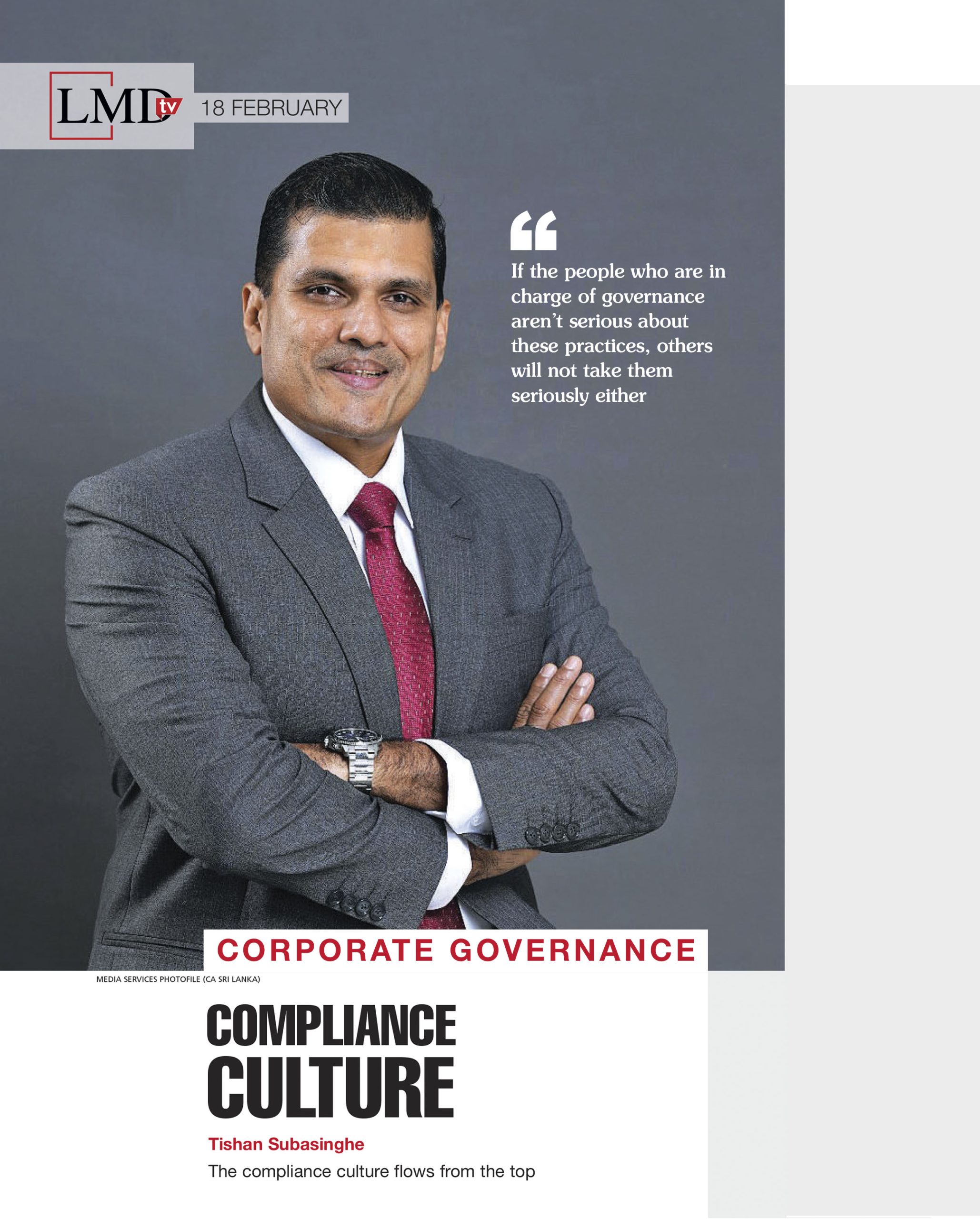
And Subasinghe emphasised that “if the people who are in charge of governance aren’t serious about these practices, others will not take them seriously either.”
“There may be many laws and regulations but the compliance mindset must come from the top – that is the one and only critical success factor,” he added.
Companies must also overcome several challenges that act as barriers to effective corporate governance, beginning with awareness – which again, starts at the top. Subasinghe noted: “The challenge is to create awareness at the top, set the right tone and foster an ethical culture.”
He elaborated: “Board directors and senior management often depend heavily on expert advice regarding compliance. In my view, when individuals join a board, they assume significant responsibility particularly in financial institutions, where that responsibility extends to the public as well.”
“The scope is broad, and directors must be familiar with relevant governance laws and regulations, rather than relying entirely on othersfor advice,” he added.
Corporate governance principles are brought to life through an organisation’s culture, which is made up of its people, Subasinghe stated.
A professional is someone who has gained knowledge over a period of time and converted it into a skill through practice. Such people are bound by a code of ethics on how to behave and discharge their duties.
In addition to this code of ethics, Subasinghe noted that there’s also a value system that is inculcated into a person from childhood by his or her parents, neighbours, relatives, teachers, lecturers and religious leaders.
“Everything comes down to the person – we have rules and regulations but governance is centred on the individual, and what he or she does when facing a difficult situation,” he added.
Subasinghe emphasised that “it doesn’t depend solely on how people work within the boundaries of a code of ethics; it also depends on one’s value system.”
This enables individuals to lead ethically professional lives, comply with best practices and do the right thing within their organisations, he concluded.