GEOPOLITICS TODAY
Geopolitics is like a game of chess. In the 19th century, when the British and Russian Empires had divided stakes across the known world, the cold war of that century was given a particular name. The famous poet and writer Rudyard Kipling, along with several other historians and analysts, called it ‘The Great Game.’
The issue at hand can be framed in a number of ways.
THE GREAT GAME OF TRUMP AND GREENLAND
Sunera Bandara examines how rhetoric, threats and strategic actions shape geopolitics as the US and China face off in a renewed global power shift
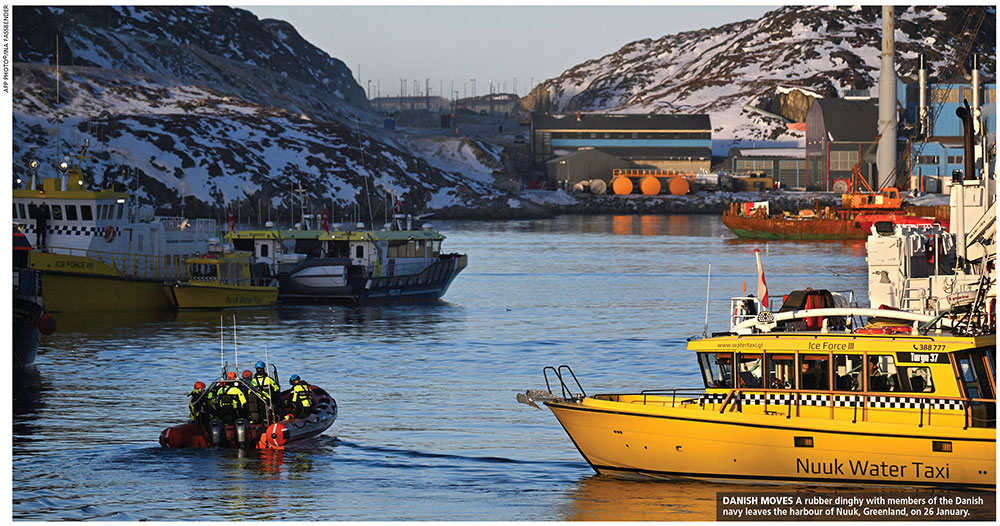
If one were to lead up to this issue with the argument that China not only has significant stakes and leverage in the Indo-Pacific region but also opened a ‘super embassy’ in London, then US President Donald Trump’s threat may appear to have some rational basis from a US foreign policy standpoint.
When analysing geopolitics, we try not to assign morality to certain actions, lest we lose sight of the broader picture.Russia invades Ukraine, India goes to war with Pakistan for a week and China repeatedly postures about taking over Taiwan.
With the latter example however, there isn’t too much of an uproar.
China and Japan are currently facing a severe diplomatic crisis.
In November, Japan’s Prime Minister Sanae Takaichi made remarks that appeared to contradict China’s ‘One China’ policy. She stated that a Chinese attack on Japan would constitute an existential crisis for her country – and she would allow Japan to take military action in collective self-defence.
The response was quite unheard of – “the dirty head that sticks itself in must be cut off” was posted on X by China’s consul general in Japan in reference to Takaichi. The post has since been deleted but it was enough to escalate a diplomatic crisis that is ongoing.
Sovereignty is an enshrined principle in the UN Charter; it is the first we must uphold before turning to any other principles for guidance. If it were argued that Trump was annexing Greenland devoid of all other inherent geopolitical factors, it would be deeply concerning that the leader of the free world is championing such rhetoric.
However, rhetoric is merely that: rhetoric. One would rather hope that China’s consul general was simply going by rhetoric and that the country’s policy towards Japan does not feature the word decapitation. Are we looking to Trump’s words to define who he is rather than what he actually does?
When analysing geopolitics, we try not to assign morality to certain actions, lest we lose sight of the broader picture
China now holds stakes within the Indo-Pacific region, which poses a major threat to the West.
The Belt and Road Initiative (BRI) has been employed by China as a soft power policy using trade routes, deals and arrangements with neighbouring countries, for the purpose of infrastructure and economic development. This economic initiative has been praised for building global networks as well as enhancing international trade.
Sri Lanka too is no exception to the rule.
The Hambantota Port was leased to China after the country’s construction contractors weren’t paid. The special economic zone around the Port City Colombo also carries a considerable Chinese stake.
Regardless of whether this is classic debt trap diplomacy, as is alleged, or a new global order reshaping the current culture of economic development remain as spheres of influence. China would likely not be pleased if the Hambantota Port leasehold was transferred to the United States.
Trump has used veiled references regarding many other countries as well. He once posted an image of himself wearing the papal tiara. Though clearly an AI generated image, it did not signal to anyone that the US president was attempting to annexe the Vatican.
Since becoming the 47th President of the United States, he has made repeated annexation related threats.
Donald Trump has expressed interest in annexing Canada, gaining control of the Gaza Strip and reclaiming influence over the Panama Canal. There have also been many references to troops on the ground in Mexico to combat cartels that the US views as an expansionist threat through the international narcoterrorist pipeline.
The key distinction is that words do not necessarily equate to actions, neither are actions always a direct result of rhetoric mentioned in the geopolitical arena.
China is opening up a super embassy in the United Kingdom – the Telegraph dispatch featuring unredacted planning documents, which reveal that a concealed chamber will sit directly alongside fibre optic cables transmitting financial data to London, as well as email and messaging traffic for millions of internet users.
Meanwhile, the Chagos Islands in the Indo-Pacific Ocean has been gifted to the Mauritian government, and Mauritius has a notable alliance and partnership with the People’s Republic of China.
These developments represent actions rather than rhetoric. They also signal, as many commentators note, a growing expansion of power from the East to the West.