
EARLY WARNING SYSTEMS
Cyclone Ditwah made landfall in Sri Lanka on 28 November and continued to wreak havoc until 2 December with a force that shook the island and its citizens to the core.

STAYING AHEAD OF TRAGEDY
By Akila Wijerathna and Saro Thiruppathy
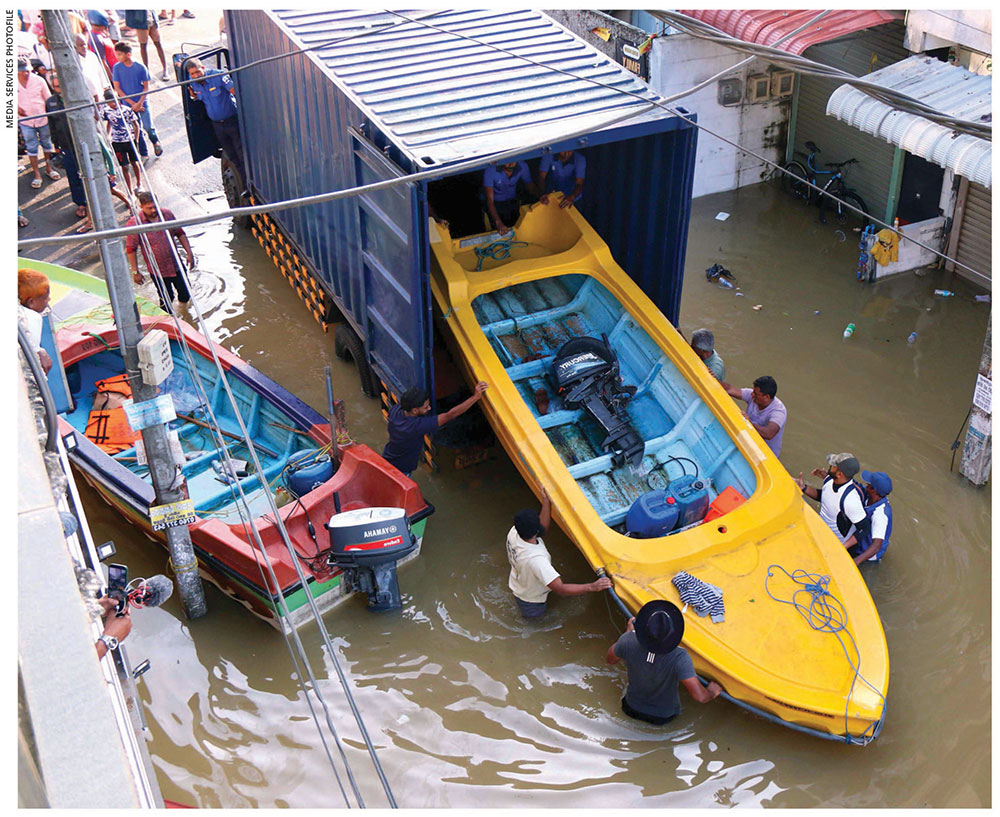
Since then, efforts have been underway to pin the responsibility for the extent of damage caused to the nation and its economy on a variety of state actors.
In retrospect, the blame game is purposeless because in addition to the tragic loss of life and livelihoods, the economy has been battered by an estimated US$ 4.1 billion in direct damage with the Kandy District alone accounting for nearly 690 million dollars in damages.
What’s of greater importance is the urgent establishment of an early warning system (EWS) that relates to weather events, which Sri Lanka will face in the future.
Authorities should review the various early warning systems across the world so the government can implement a hybrid system that will protect the economy, the people and their assets, as well as natural resources – such as water that is needed for agriculture, electricity generation and protection from heatwaves.
Since the state is ultimately responsible for the security of the nation, it must develop a comprehensive EWS that covers all environmental risks
EARLY WARNING Timely action must begin from the moment the Department of Meteorology issues its first warning about environmental hazards such as tsunamis, cyclones, floods etc. – and relevant systems should be in place so that the process is activated without the need for lengthy discussions.
Disaster preparedness should include the establishment of robust processes in each district that can provide shelter, food, medical assistance, and search and rescue operations. The most important aspect is effortless communication mechanisms that don’t depend on terrestrial lines and can be implemented via satellite communication equipment.
Efficient EWS can reduce potential damage by at least 30 percent with only 24 hours’ notice. Nevertheless, risk knowledge gathering, monitoring, communication and community preparedness must also be in place so that when a climate event is imminent, the authorities and residents can engage without delay.
This will enable residents who are at risk to seek shelter in places that have already been earmarked by district authorities; and they will have sufficient time to secure their assets, move animals to safe spaces and activate community drills.
Community leaders should issue warnings to the residents via social media, SMS alerts, loudspeaker announcements and door-to-door messengers. And communication must be in Sinhala, Tamil and English. Simply making announcements in Sinhala will defeat the purpose.
The state must issue regular alerts on TV and radio in all three languages, so that people will recognise the severity of the potential hazard and follow community guidelines.
Communities should practise evacuation and hazard prevention exercises periodically so that they aren’t caught by surprise in the event of a threat. Sri Lankans could learn from the Filipino board game Master of Disaster, and also continue with street dramas to educate and prepare community members to face disasters.
The district and divisional secretariats must establish fully equipped safe locations – i.e. in schools, temples and community centres among others – for those seeking shelter during climate events. Meanwhile, hospitals and ambulance services must also be stepped up to receive injured survivors.
A team of naval, air force and army personnel must always be on standby for emergency mobilisation to prevent delays in responding to a crisis.
And the Department of Meteorology needs to work very closely with its Indian counterpart, which is constantly on the lookout for cyclones developing in the Bay of Bengal, in the greater Indian Ocean region, and other events such as earthquakes and tsunamis.
ASIAN TSUNAMI Sri Lanka was caught unawares in the lead up to the 2004 Asian tsunami, which struck Aceh at 6.30 a.m. on 26 December and reached us two hours later. In spite of having this lead to get to safety, some 35,000 people died that day because there was no early warning system in place.
Tsunami prone countries and states have established Multi-Hazard Early Warning Systems (MHEWS) due their close proximity to the Pacific Ring of Fire via initiatives such as the WMO backed CREWS Pacific SIDS 2.0, Pacific Tsunami Warning System (PTWS) and Joint Typhoon Warning Center (JTWC).
These protocols help strengthen national capabilities in detecting, forecasting and disseminating early warnings about earthquakes, tsunamis, hurricanes and storms in the region.
Though Sri Lanka did attempt to close the stable doors once the horses had bolted, the need to maintain the disaster preparedness plan that had been developed fell between two stools. Subsequent climate disasters could have been mitigated if the authorities had pursued with the plan.
ENVIRONMENT Climate resilience is a must for countries that are vulnerable to rising seas levels, floods, landslides and other calamities.
It’s imperative that Sri Lanka’s environment is maintained in pristine condition so that the nation is always prepared in the event of a sudden event. Estuaries and canals must be widened and regularly cleaned of debris, embankments strengthened on river banks, water level in reservoirs reduced to accommodate extremely high rainfall, river flood basins clearly demarked and residents warned about life-threatening flooding.
CURRENT EWS There are four pillars for an efficient early warning system: disaster risk knowledge; detection and forecasting; warning dissemination and communication; and preparedness and response.
EWS include sensors such as satellites, seismographs, DART buoys, ground sensors and weather stations. Communication methods use sirens, SMS alerts, TV and radio broadcasts, loudspeakers and social media. Community empowerment is central to this effort of saving lives and being linked to the International Network for Multi-Hazard Early Warning Systems (IN-MHEWS) provides access to global best practices.
The UN’s Early Warnings for All (EW4All) initiative aims to protect all persons with early warning systems by 2027, and considers it a cost-effective and proven means of saving lives, assets and economies.
Meanwhile, EWS in India and Japan provide a peek into what’s available in the world.
INDIA Cyclone warnings are issued to state and government officials in four stages. The pre-cyclone watch is issued 72 hours ahead about the development of a cyclonic disturbance in the northern Indian Ocean, its possible intensification into a tropical cyclone and the coastal belt that’s likely to experience adverse weather.
This is issued by the Director General of Meteorology and addressed to the Cabinet Secretary and other senior officers in the government – including the chief secretaries of concerned maritime states.
The cyclone alert is issued at least 48 hours ahead of the potential adverse weather situation over the coastal areas. It contains information on the location and intensity of the storm, the anticipated direction of movement, intensification and the coastal areas that could experience extreme weather.
A cyclone warning is issued at least 24 hours in advance of the event over the coastal areas. The place of landfall is forecasted at this stage and warnings are issued every three hours – they will provide the latest position of the cyclone and its intensity, and projected point and time of landfall.
This warning also provides anticipated rainfall, wind intensity and storm surges along with their impact.
The post landfall outlook is issued at least 12 hours ahead of the expected time of landfall. It indicates the possible direction of the cyclone after it makes landfall and adverse weather that may be experienced in the interior areas.
Warnings are disseminated via radio, and national and regional television channels. Meanwhile, a system of disseminating warnings to fishermen through World Space Digital based radio receivers is also being planned.
The entire process involves a strong early warning system, climate resilient infrastructure, community drills, and structured state and centre responses. These efforts focus on timely evacuation and social inclusion through women’s self-help groups for example, for better outreach. Success has been seen in near-zero casualty events despite the increasing intensity of storms.
JAPAN Following the Fukushima disaster in 2011, Japan is using technological upgrades and infrastructure projects that can detect offshore seismic activity, and provide quicker and more accurate information for early dissemination.
These improvements include an Ocean Floor Monitoring Network with thousands of kilometres of cabled sensors and pressure gauges along the Japan Trench. The sensors can detect the early primary waves and changes in water pressure much faster than land based systems, and provide seconds to minutes of warning before tsunamis or strong tremors hit the country.
It also enables direct real time monitoring of zones where major earthquakes originate. And the Japan Meteorological Agency (JMA) has established new algorithms to improve the accuracy and speed of its earthquake warnings.
Warnings in multiple languages are broadcast rapidly via TV, radio, chimes, announcements, maps of potential areas that could be affected, SMS alerts, and public address systems with loud speakers on rooftops and streets to broadcast emergency evacuation instructions – particularly for the elderly who may not be using smartphones.
Tech upgrades work in tandem with extensive community training that includes regular evacuation drills, and knowledge about earthquakes and tsunamis. Students are using gamified drills to simulate obstacles so that disabled individuals can identify gaps in evacuation plans.
Since the state is ultimately responsible for the security of the nation, it must develop a comprehensive EWS that covers all environmental risks that Sri Lanka may very well face in the future.