INVESTOR FORUM
DE-RISKING ENTREPRENEURSHIP
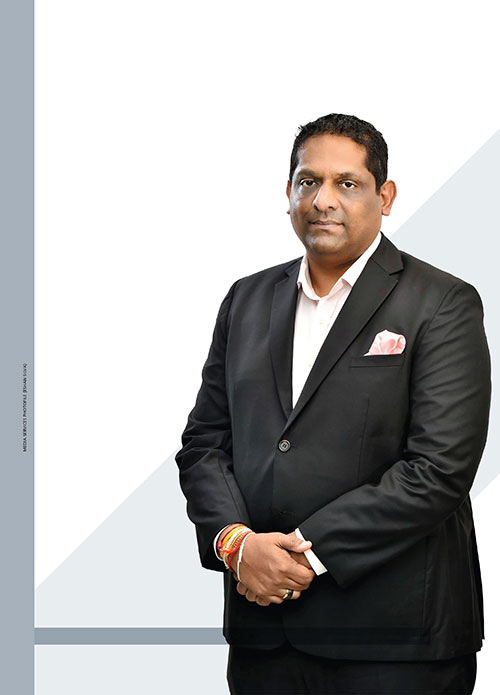
Nathan Sivagananathan explores the realities of the entrepreneurial landscape
Q: Has Sri Lanka genuinely embraced entrepreneurship or do we still celebrate stability over risk?
A: The country still celebrates stability over risk. While entrepreneurs are praised publicly, society rewards predictability, secure jobs, safe balance sheets, established names and the idea of not embarrassing the legacy.
How we treat a business owner’s setback reveals our mindset: ‘what went wrong’ instead of ‘what you learned.’ Failure is seen as a stain rather than part of progress. In successful entrepreneurial ecosystems, it is a step towards success.
Experimentation, risk and failure are necessary for long-term economic growth.
Q: Are we building globally competitive companies or are most ventures constrained by a domestic mindset?
A: We can build globally competitive companies but many ventures remain constrained by domestic gravity.
The first constraint is market size and price ceilings, which push businesses towards small optimisation rather than bold differentiation. Yet, we sit next to India’s 1.3 billion person market. Instead of viewing it as a barrier, we should see it as Mexico leveraged its proximity to the US – an opportunity for integration and scale.
Secondly, talent structures often reward seniority over output and companies are overly cost conscious about hiring talent early.
And thirdly, sales mentality values relationships but ‘relationship first’ selling creates complacency. Instead of building repeatable global distribution systems, companies rely on networks and prefer selling over partnerships for scale.
The broader gap is that too few local ventures are built with global product discipline from day one – i.e. strong unit economics, compliance readiness, scalable operations and predictable delivery.
Q: Is there a shortage of capital in Sri Lanka or a shortage of conviction?
A: Capital and conviction are both limited but the greater constraint is conviction. The country has capital in personal wealth and corporate balance sheets; what’s scarce is capital that can tolerate volatility without panicking, interfering or demanding guarantees.
International investors have opportunities elsewhere and remain cautious without policy stability. A weak sovereign rating means Sri Lanka must work harder to build investor confidence. Much local capital is return seeking not risk bearing, behaving more like banking capital than venture capital.
True venture investing requires patience. Globally, cycles run seven to 10 years; in Sri Lanka, they often stretch to 10-12 years, demanding greater investor conviction.
Q: Do local investors truly understand venture capital risk or do they expect traditional asset class returns from startups?
A: Local investors struggle with venture risk, expecting asset class certainty similar to real estate or secured lending. Many focus on fixed returns and seek control rights that stifle founders and slow decision making.
The result is a demand for venture style upside with bank style downside protection, weakening the entrepreneurial ecosystem and preventing the risk taking needed to build high growth companies.
Q: Are family owned conglomerates open to disruption or are they stifling it inadvertently?
A: Family owned conglomerates believe they are disruptive but can unintentionally stifle disruption. They bring advantages – distribution, credibility, capital and experience – but tend to optimise existing cash flows rather than cannibalise them.
When disruption threatens core businesses, responses become cautious. And this delays decision-making, leads to forming committees and running endless pilots or acquiring new ventures, only to domesticate them.
Successful conglomerates create separate innovation vehicles with autonomy, independent leadership and different success metrics.
Q: So is our regulatory framework innovation friendly or structurally hostile to risk taking? How has policy inconsistency damaged foreign investor confidence?
A: Sri Lanka’s regulatory framework is not consistently anti-innovation but is structurally hostile to risk due to slow approvals, unclear rules, sudden policy shifts and inconsistent enforcement.
For investors, inconsistency is worse than difficulty. Risk can be managed but unpredictability cannot.
When contracts or policies become politicised, investors demand higher risk premiums or stronger guarantees, or they exit. Sri Lanka needs policy continuity; a change in government should not automatically mean a change in industry policy.
Q: Are we losing our most ambitious founders to overseas markets as they see limited opportunity here?
A: Ambitious founders are leaving not only for financial reasons but for clearer rules, stronger systems, larger markets, deeper talent pools and investors who understand venture dynamics.
Many would retain Sri Lanka as a base if they could trust that policy shifts, payment systems and regulatory delays wouldn’t derail timelines. Processes that take a year elsewhere can take three years in Sri Lanka, pushing entrepreneurs to relocate.
Q: Are local corporates moving fast enough on AI and digital transformation? Or are they at risk of becoming obsolete?
A: Corporates are slow on artificial intelligence and digital transformation, risking being leapfrogged. Smaller teams use AI to cut costs and time, while regional competitors automate compliance, finance, service and forecasting.
Many corporates digitise old processes instead of redesigning them around AI, resulting in costly modernisation rather than real transformation.
Q: What is one hard truth Sri Lanka must confront if it wants to become a serious innovation hub?
A: Sri Lanka cannot become an innovation hub until it becomes a trust hub. Trust requires policy continuity, contract sanctity, reliable enforcement, transparent tax and foreign exchange frameworks, and institutions that don’t change rules midway.
Innovation thrives when entrepreneurs can take risks without fearing arbitrary outcomes. Today, much entrepreneurial energy goes into managing uncertainty rather than building globally competitive companies and products.