
ENERGY SECURITY

THE STRAIT OF HORMUZ EFFECT
Fazmina Imamudeen ponders on how hostilities in the Middle East are affecting Sri Lanka
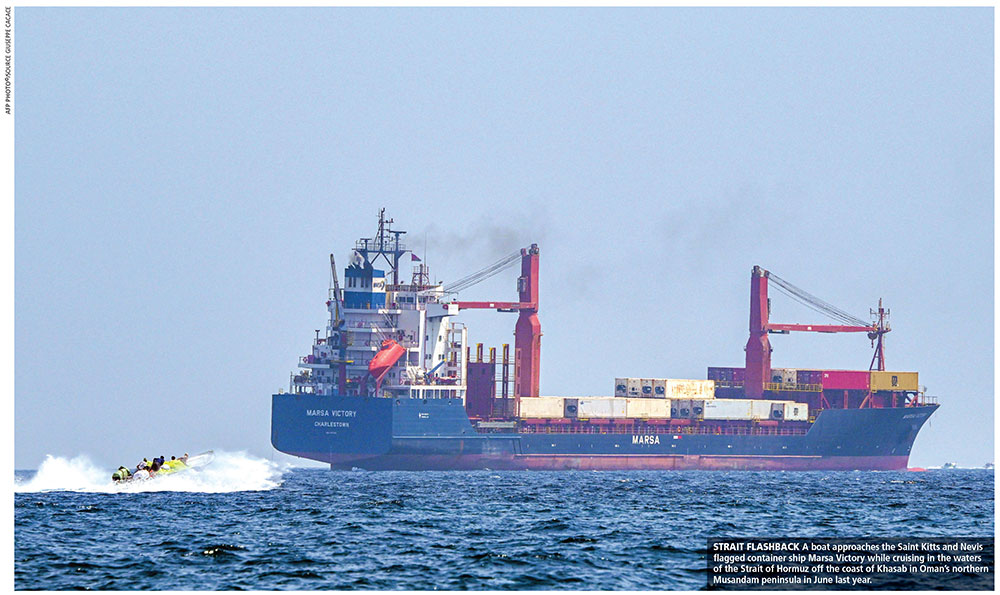
The Strait of Hormuz occupies an extremely important position in the global energy system. At a little over 30 kilometres at its narrowest point, it carries nearly a fifth of the world’s oil supply and links production in the Gulf region to markets across Asia.
Its strategic importance has long been recognised. What is increasingly evident is how disruptions in this marine corridor are experienced far beyond its geography through a steady transmission of economic pressure rather than a single, immediate shock.
Sri Lanka provides a clear illustration of this dynamic: as an import dependent energy economy, it remains closely tied to movements in the world’s oil markets.
Developments in the Middle East are first reflected in international oil prices, followed by increases in freight and insurance costs, and ultimately in the landed price of fuel. By the time these changes become visible domestically, they have already begun to influence transport, electricity generation and production costs.
The effects tend to emerge gradually. Costs rise in increments, narrowing margins and shaping operational decisions. Businesses adjust their expenditure and activity with greater caution, while households respond through measured changes in travel and consumption.
These adjustments may appear limited in isolation but collectively, they influence the pace and stability of economic activity.
At certain points however, the underlying strain becomes more visible.
Fuel queues reappear and QR based rationing mechanisms are used to regulate access and distribution. Weekly quotas are adjusted in response to supply conditions, reflecting constraints within the system. These developments are familiar in Sri Lanka’s recent experience and their recurrence suggests that such pressures are no longer confined to exceptional circumstances.
It’s important to distinguish the present situation from the economic crisis of 2022.
That episode was largely shaped by domestic factors including fiscal imbalances and a shortage of foreign exchange. The current strain is externally driven and linked to disruptions in global energy flows.
Countries across Asia and other regions are also experiencing rising prices and supply uncertainty, and this places Sri Lanka within a broader global pattern.
Recent developments have led to an additional dimension: Iran has publicly indicated that it is prepared to supply fuel to Sri Lanka if requested while also stating that access through the Strait of Hormuz remains open to what it considers ‘friendly countries.’
Though no formal arrangement has been announced, this statement reflects how energy flows – particularly during periods of disruption, which are influenced by both market conditions and state level assurances.
Meanwhile, the economic implications extend beyond fuel itself.
Higher import costs place sustained pressure on foreign exchange reserves and complicate currency management. Inflation follows through transport and production channels, which affect both businesses and households.
Since repeated exposure to such conditions can influence behaviour, caution and shorter planning horizons are encouraged.
Sri Lanka’s policy responses have become more coordinated in managing supply constraints and structuring demand through mechanisms such as QR based distribution. These measures support short-term stability. Nevertheless, the question remains whether they address the persistent underlying exposure to disruptions that seem to appear with increasing frequency in a globalised environment.
The Strait of Hormuz may be geographically distant, yet its influence on Sri Lanka is both immediate and recurring. Its disruption is reflected not only in pricing structures but also how access to fuel is organised within the country.
This raises broader considerations around energy security and long-term planning, particularly for import dependent economies that remain exposed to external shocks beyond their immediate control.
The more relevant question is not simply how these episodes are managed – but how consistently they can be expected to reappear within an increasingly uncertain global energy landscape.