
LMDtv 5
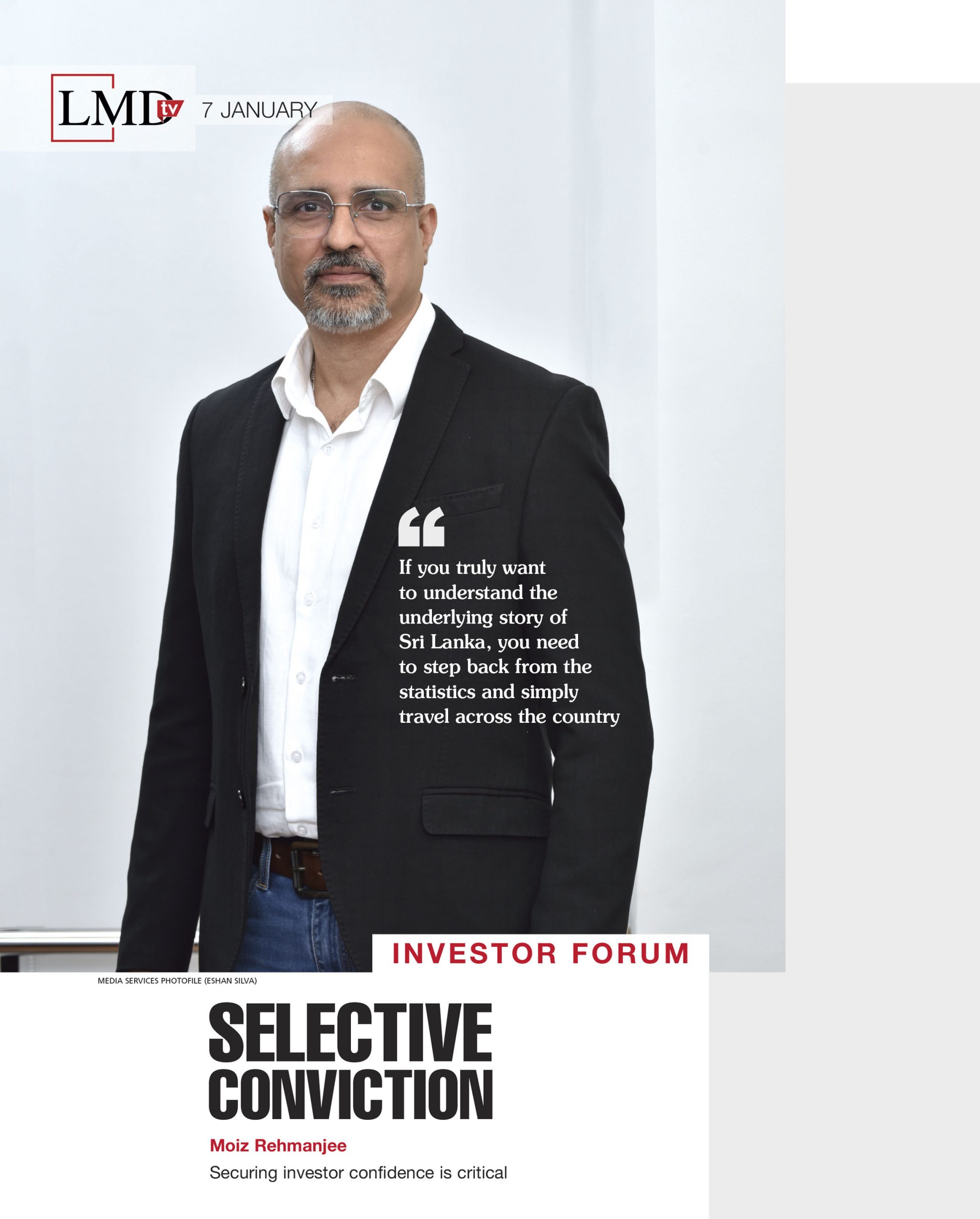
Despite a series of unfortunate events, Sri Lanka has achieved a measure of stability. But what comes next? The Group Chief Financial Officer of Hemas Holdings Moiz Rehmanjee questioned what Sri Lanka is offering investors who enter the country with certain expectations.
Speaking recently on LMDtv, he said that in addition to ensuring stability, establishing a diverse portfolio of investments and industries is also critical. Rehmanjee noted that Sri Lanka needs to have a much wider basket.
He explained: “If you take Sri Lanka’s apparel industry, it has experienced periods of growth and decline over the past two or three years. However, if you adopt a long-term vision and consider a five year average, it hasn’t grown as much as some other industries and sectors – such as value added agriculture and maritime services, where growth has been notably stronger.”
Certain East Asian countries that also began doing business around the same time as Sri Lanka have diversified extensively instead of focussing predominantly on one or two industries, he added.
But Sri Lanka has largely stagnated, he opined: “If we had a diversified portfolio irrespective of global developments, we’d have the permutation combinations within our internal basket to rely on. That is something we currently lack.”
Rehmanjee elaborated: “A hot topic today is Sri Lanka’s location at the southern tip of one of the largest and fastest growing economies in the world – and whether we can effectively leverage that advantage.”
“The world is moving away from universal liberalism towards regional or country to country FTAs. How many countries can we realistically sign free trade agreements with? And how many have we ticked off already? These are the questions we need to be addressing,” he urged.
Sharing his thoughts on investments in tech based businesses, he asserted that “technology is not the only area in which opportunities exist,” adding that therefore, we need to identify our sweet spot because we’re not operating in isolation.
When you talk about core competencies and talent pools, competitors such as India, the Philippines and other East Asian countries are around us. We must determine what makes Sri Lanka distinctive, he added.
Sri Lanka has also expressed an interest in positioning itself as a hub for digital nomads, though it remains unclear whether the country has successfully positioned itself on the world map of nomads.
Rehmanjee observed: “Sri Lanka scores high in areas such as cost of living, real estate, accommodation, education and healthcare. We offer an easygoing lifestyle, a high quality of life and a friendly culture. Expats who are already here are enjoying life, and we see digital nomads and retirees choosing to spend their time in Sri Lanka. But have we truly marketed ourselves as a suitable destination?”
As he said, to market ourselves we need to engage with the international media and demonstrate that Sri Lanka is far more than a country recovering from an economic crisis, political turmoil or a climate disaster. We need to showcase the many positive developments going on in Sri Lanka.
The island’s resilience and ability to bounce back are key attractions that should draw the attention of investors, he noted. “Sri Lanka maintains a slow and steady pace, resilience and stability – these are factors investors should be taking into account,” he added.
Rehmanjee continued: “Yes, there has been brain drain and an outflow of investors. However, if you truly want to understand the underlying story of Sri Lanka,you need to step back from the statistics and simply travel across the country, interact with its people and most importantly, speak to investors who have chosen to stay here.”
“Ask them what they are seeing that those who are flying out aren’t? That is probably where you will find the silver lining and light at the end of the tunnel,” he asserted.
In his view, the sentiment with which investors should approach Sri Lanka is one of selective conviction.