BANKING SECTOR
Compiled by Allaam Ousman
SPOTLIGHT ON RISK MITIGATION
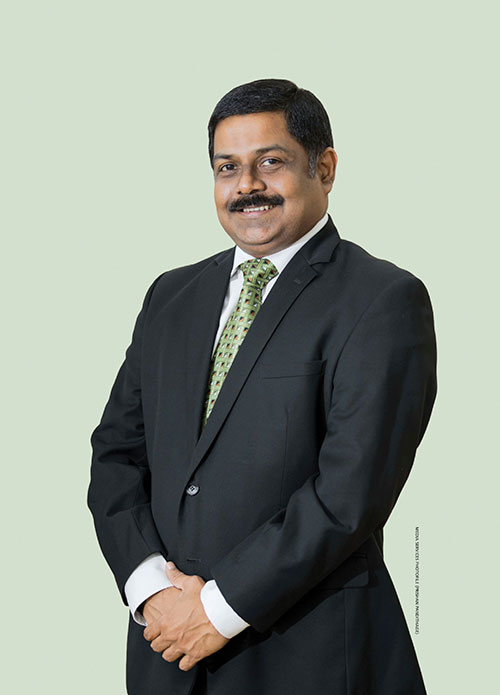
Sivakrishnarajah Renganathan assesses the risk profile of the banking sector
Q: With evolving regulatory expectations and tightening capital requirements, how is the banking sector adapting to ensure long-term stability and resilience?
A: In my view, banks operating in Sri Lanka have managed to maintain adequate capital levels and are closely monitoring the need to hold sufficient buffers in addition to meeting regulatory requirements.
However, certain banks face challenges in maintaining adequate capital – especially amid the increasing demand for advances driven by the current low interest rate environment.
Sri Lankan banks have encountered several unprecedented challenges and demonstrated their resilience in the past. I am confident that most will continue to strengthen their resilience in response to new challenges.
The regulator – the Central Bank of Sri Lanka – is dynamic and committed; its highly capable teams monitor the sector, provide necessary guidance to banks and take appropriate action when required.
Q: In light of the prevailing macroeconomic environment, what are the main risks facing the banking sector – and how should banks position themselves to navigate them?
A: In the current macroeconomic environment – which is characterised by elevated interest rates, persistent inflationary pressures, geopolitical uncertainty and rapid digital transformation – the banking sector faces three broad categories of risk: credit risk, market and liquidity risk, and operational risk.
Among these three major risks, operational risk seems to be increasing rapidly in the banking sector, driven largely by technology dependence and digitalisation. Tech related risks are evolving faster and in many different ways.
Banks must therefore enhance vigilance in identifying such risks through robust risk and control self-assessments (RCA), and remain agile in seeking ways to mitigate such risks.
Q: How has the role of a banker evolved over the last four decades? And what competencies define a successful banker, in your view?
A: I began my banking career at a time when adding machines were widely used. Today, the sector relies on sophisticated computer systems and fully automated digital platforms to deliver banking services.
As a result, bankers are expected to be up-to-date with technological skills and be innovative to resolve customer requirements in a more competitive world.
Bankers are required to possess high digital fluency, and an analytical and agile mindset coupled with strong soft skills to delight customers with more customised solutions. In this evolving landscape, a successful banker is one who can seamlessly combine technology, insight and human judgement, to deliver value driven and customer centric solutions.
Q: What are the most common financial misconceptions you see among customers today – and how can banks better educate and empower them?
A: In today’s digital banking world, a common misconception among customers is the belief that banks are solely responsible for protecting accounts – and that customers have little or no role in managing security risks.
Many customers do not fully understand their responsibility to safeguard access credentials, avoid sharing sensitive information, and respond carefully and diligently to communications from their banks.
Scammers have succeeded by exploiting customer ignorance through phishing, social engineering and impersonation tactics, taking advantage of the lack of awareness around digital security practices.
At the same time, there are instances when banks may have failed to provide adequate coverage due to gaps in fraud monitoring, delayed alerts, insufficient authentication controls or unclear communication regarding customer responsibilities.
These combined weaknesses highlight the importance of a shared responsibility model between banks and customers in preventing financial fraud.
Q: With digital transformation reshaping the sector, how can bank’s balance tech innovation while maintaining trust, personal relationships and human judgement?
A: I strongly believe in a hybrid model of banking relationships, where technological advancements are used at the highest level to provide customised solutions to all banking relationships.
Banks must ensure that sufficient investments are made to provide personal interactions, which will build trust and confidence among customers.
At present, I do not see any bank in Sri Lanka having developed a robust chatbot that is able to replace the value of human support. While improving such platforms, banks must also enhance their call centres with adequately trained staff and increase virtual interactions through video platforms to preserve meaningful contact.
Q: What risk management practices should banks strengthen in order to remain resilient and competitive?
A: Compared to past years, risk management within the banking sector now relies heavily on statistical models and specialised software solutions, to manage risks and be resilient.
However, banks are now moving towards machine learning, advanced analytics and AI usage, to predict more accurate scenarios and enhance risk management practices.
Cybersecurity is a major risk area, and banks need to be agile and move beyond outdated infrastructure to safeguard against highly sophisticated threats.
Before deploying any software system, banks should evaluate all the risks associated with such solutions – including version reviews among others –and ensure that it is monitored frequently.