LMDtv 3
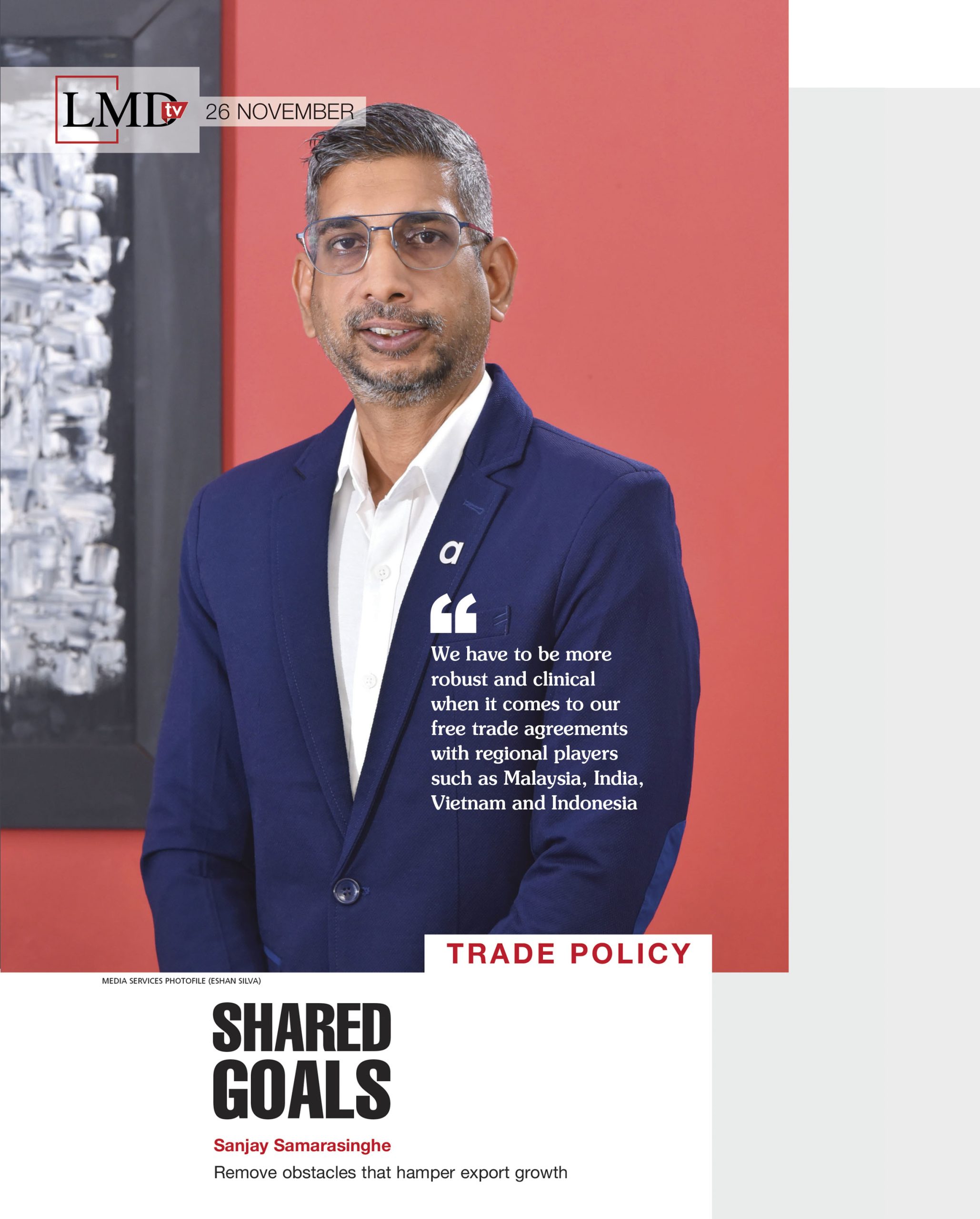
According to the Country Manager and Director of Aramex Sanjay Samarasinghe, reforms to trade policy and practices is the need of the hour: “There is some [degree of] macroeconomic stability, mainly driven by debt restructuring negotiations.”
“And now, it’s about how we work on the structural changes – be they regarding trade policy, governance issues or legislation,” he said, during a recent LMDtv interview.
He highlighted the importance of trade policy reforms to support Sri Lanka’s growing economy and exporters: “You have to do some things simultaneously since there’s no quick fix for most of the problems we have because they are deep-rooted in how we think as a people and also due to a lack of knowledge where policy should be implemented.”
He continued: “In the short term, we could look at removing some of the tax burdens that are imposed on exporters who import raw materials… We have too many para tariffs, and so a quick fix would be to address the export requirements – both current and future; and then remove some of those para tariffs for the inward movement of raw materials.”
“In the long term, we have to be more robust and clinical when it comes to our free trade agreements with regional players such as Malaysia, India, Vietnam and Indonesia,” he noted, adding that if we work on these short-term and long-term needs, we’ll see some traction.
Samarasinghe maintained that many reforms should be introduced to the country’s trade policy, including the inclusion of services. “Historically, we haven’t seen services and professions included in trade negotiations,” he said. This is mainly driven by a lack of understanding among communities and diverse political agendas.
And he attributed Sri Lanka’s trade policy limitations to its protectionist stance: “We claim to have become liberal in the 1960s and ’70s; but we were one of the most protectionist economies in the world, and are certainly still one of the most protectionist economies in the region.”
Samarasinghe feels that “there needs to be a holistic view about how we’re going to manage this situation since liberalisation is the need of the hour – and we need to do it in a way that makes sense, especially considering that we are so late into the game.”
He noted: “For instance, you have to create funds and programmes where you can work with inefficient exporters or domestic players, to reskill and upskill them to seek new avenues of business.”
Though commodity exports are another high-potential area, it doesn’t receive much attention. He explained: “We have a lot of potential for commodity exports. A recent example was Ceylon Cinnamon, which has been marketed worldwide without any support from the government or policy makers.”
“Over the last 10-15 years, those of us in logistics have seen many products being exported out of Sri Lanka but without much focus from a country perspective,” Samarasinghe lamented.
He continued: “Items such as dried mango leaves have many listings on Amazon and eBay, most of which are from small-scale Sri Lankan entrepreneurs. The problem is sustainability because no one is focussed on them and they don’t have the right tools or knowledge.”
“So they enter the market, grow their business, make some money and then buy a car or an apartment. But two years down the line, they might make some mistakes and lose their business,” he explained.
Educating people is the need of the hour for Sri Lanka in order to harness the country’s economic potential.
Samarasinghe elaborated: “Sri Lanka needs to understand economics, what it means, and how it’s driven locally in order to emerge from where we are and progress towards where we want to bein the next five years.”
“All stakeholders must be involved and have the same end goal. It’s important to align everyone in that direction, and then give them the leverage and freedom to work towards achieving that objective by enabling them sans roadblocks,” he urged.