THE ARAB COLD WAR

US-SAUDI PACT: A NEW MIDDLE EAST SHIFT
Sunera Bandara contemplates the new Arab Cold War and its geopolitical implications within the Middle East as a US-Saudi deal is finalised
Post the Gaza ceasefire, a proposed F-35 fighter jet deal is up for grabs. Israeli-Saudi state relations normalisation is being discussed: so has the Arab Cold War reawakened?
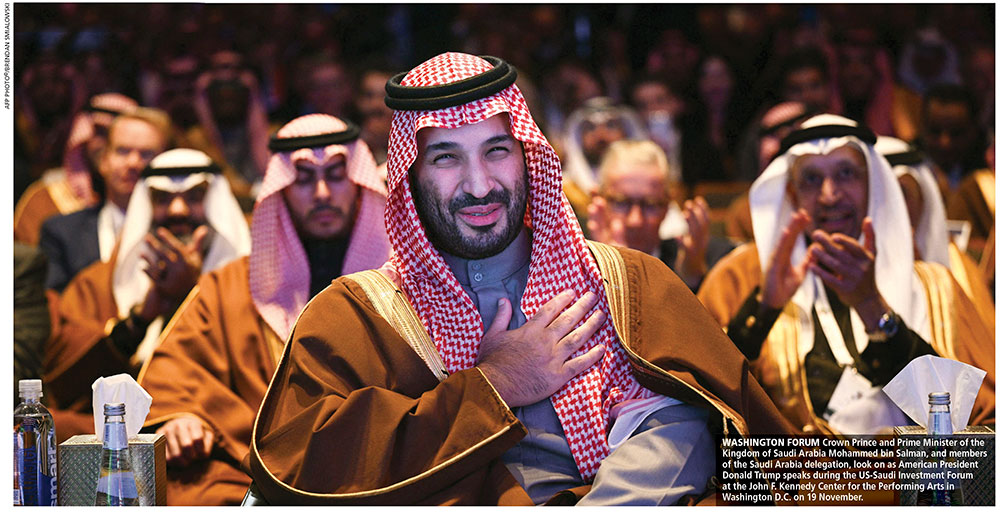
On 18 November, Saudi Arabia’s Crown Prince Mohammed bin Salman (MbS) met with US President Donald Trump in Washington D.C. for a two day visit, after which a pact between the two nations was finalised.
Often described as a reformer, the crown prince has been implementing initiatives encompassing the creation of a ‘New Arabia’ as set out in his Vision 2030 programme – an ambitious government project launched in 2016 aimed at diversifying the Saudi economy amid a neoliberal global world order.
Having visited the US earlier in May and pledged US$ 600 billion in investments, MbS has now increased this commitment to the tune of one trillion dollars.
Saudi’s new focus is on diversifying its economy. And while a shift away from a religion centred culture received acclaim, it developed alongside the kingdom’s own skeletons. Saudi Arabia has been reprimanded internationally – from the assassination of journalist Jamal Khashoggi to its infamous treatment of women – leading to accusations of attempting to whitewash its legacy.
However, with investments into tourism and AI, Saudi Arabia is rebranding and repositioning itself away from its former image.
There is far more however, than meets the eye.
The US positioned alignment comes with conditions. Though the Saudis will receive F-35 fighter jets as part of the deal, this includes the caveat that United States law requires maintaining Israel’s qualitative military edge (QME) in the region. The normalisation of Saudi-Israel relations is also among the bets placed on the table.
Commonly framed by analysts as the ‘Arab Cold War,’ the Middle East has experienced its fair share of proxy conflicts.This geopolitical theme, notable since the 1950s, waned after Israel’s six day victory against Egypt in 1967. By the mid-1970s, Saudi Arabia, Oman and emerging Gulf States such as Qatar dominated the regional landscape by leveraging vast oil revenues.
As a result, the ideological framework of conservative monarchism – focussing on the independence of states within the region – won out against secular socialist pan-Arabism. Conservative monarchies rooted in traditional Islamic principles aligned with Western states while socialist republics such as Egypt aligned with the USSR.
Classically, Saudi led the conservative bloc against Egypt’s pan-Arabist socialist coalition – reflected clearly in the 1967 war. Misleading Soviet intelligence on Israeli troop movements led Egypt to cut off Israel’s access to the Red Sea. Pre-emptive airstrikes by Israel destroyed 300 Egyptian based aircraft within hours.
Jordan and Syria, bound to Egypt by defence pacts, joined in the conflict but were outmanoeuvred by Israel, which went on to capture the West Bank and East Jerusalem. The Egyptian leadership’s ploy to upend Saudi dominance ended instead with Egypt’s aura of military dominance being shattered – and with it, the dream of pan-Arabism.
Fast forward to the present day…
America has brought Saudi closer through the new pact and rubberstamped the process through the formal designation of the nation as a major non-NATO ally. This ties it to NATO’s stance against Russian expansionism. Former US president Joe Biden similarly granted the designation to Qatar in 2022, shortly after the Russian invasion of Ukraine.
Qatar once aligned with Saudi interests and considered a vassal state, has been a regional competitor since 1995. Outflanking its past, and moving towards soft power approaches and pragmatism, Qatar has attempted to dethrone Saudi’s regional dominance.
Embracing the use of Islamist forces, namely the Muslim Brotherhood, in conjunction with its objective – which states such as Saudi and Jordan had done away with previously – Qatar gambled on taking over during the Arab Spring.
These events and the subsequent narrative amplified by Al Jazeera – the Doha based news network semi funded by the Qatari government – contributed to the eventual Saudi-Qatar diplomatic crisis in 2017.
The 2025 pact therefore, marks a rapid shift in regional stakes. While Saudi Arabia and the US remain closely allied, Qatar also maintains a friendly relationship with America. With current strategy framed around defence, regional stability and economic dominance, questions arise as to whether the Arab Cold War is recurring. The Abraham Accords are on the table, and Qatar and Saudi stand opposed.
An initial designation of some Muslim Brotherhood chapters throughout the world sansQatar – following the 18 November meeting – sparked debate. The Jerusalem Post argued the move failed to address “the role of state enablers like Qatar” while Al Jazeera associated the blacklisting with “the longstanding demands for right wing activists in the US.’
The pact raises more questions than answers. Shifting alliances, changing political winds and state relationships mired by friction may well contribute to the emergence of a new Arab Cold War.